Welcome
The JSAA is the professional association for those in Australia who teach, research or study Japan. The Association was established in 1978, and membership is open to Japanese Studies practitioners in Australia and overseas. Become a Member ⟶
Recommendation of the Translation of Titles in the Australian Academic System to Japanese
In Australia, academic titles and their hierarchy within universities differ from those in Japan, leading to a significant disparity between the titles employed in the Australian system and their direct translation into Japanese. This has been causing misunderstanding and negatively affecting Australian academics in Japan.
Of particular note, the titles of "Senior Lecturer" and ‘Associate Professor’ in Australia carry a higher level of status and prestige compared to their equivalent translations in Japan.
Here's an overview of academic titles in Australia and how they differ from Japan.
Academic Titles in Australia:
Lecturer: This is typically the entry-level academic position in Australia. Lecturers are responsible for teaching and may engage in research activities as well.
Senior Lecturer: A more senior teaching and research position, similar to an Associate Professor (准教授, Jun-Kyōju) in Japan. The position also typically entails managerial responsibilities at the school level.
Associate Professor: This title is used for academics with significant teaching, research experience as well as substantial managerial responsibilities at the faculty level. It is somewhat equivalent to a "Full Professor" (教授, Kyōju) in Japan.
Professor: In Australia, the title of "Professor" is the highest academic rank and is associated with a distinguished record of teaching, research, and service. It is regarded as a prestigious title and carries high status. Japan uses the title "Professor" (教授, Kyōju) for top-ranking academics, but it may not carry the same level of prestige as in Australia.
In light of these differences, the Japanese Studies of Australia (JSAA)recommends to standardise the translation of these titles as follows:
Lecturer: 上級講師, Jōkyu-Kōshi
Senior Lecturer: 准教授, Jun- Kyōju
Associate Professor: 教授, Kyōju
Professor: 教授, Kyōju
This standardisation will help bridge the gap in understanding the differences between the Australian and Japanese academic systems and promote a more accurate representation of academic titles in both contexts.
These videos promote Japanese language education at Japanese Studies at university.
Latest News
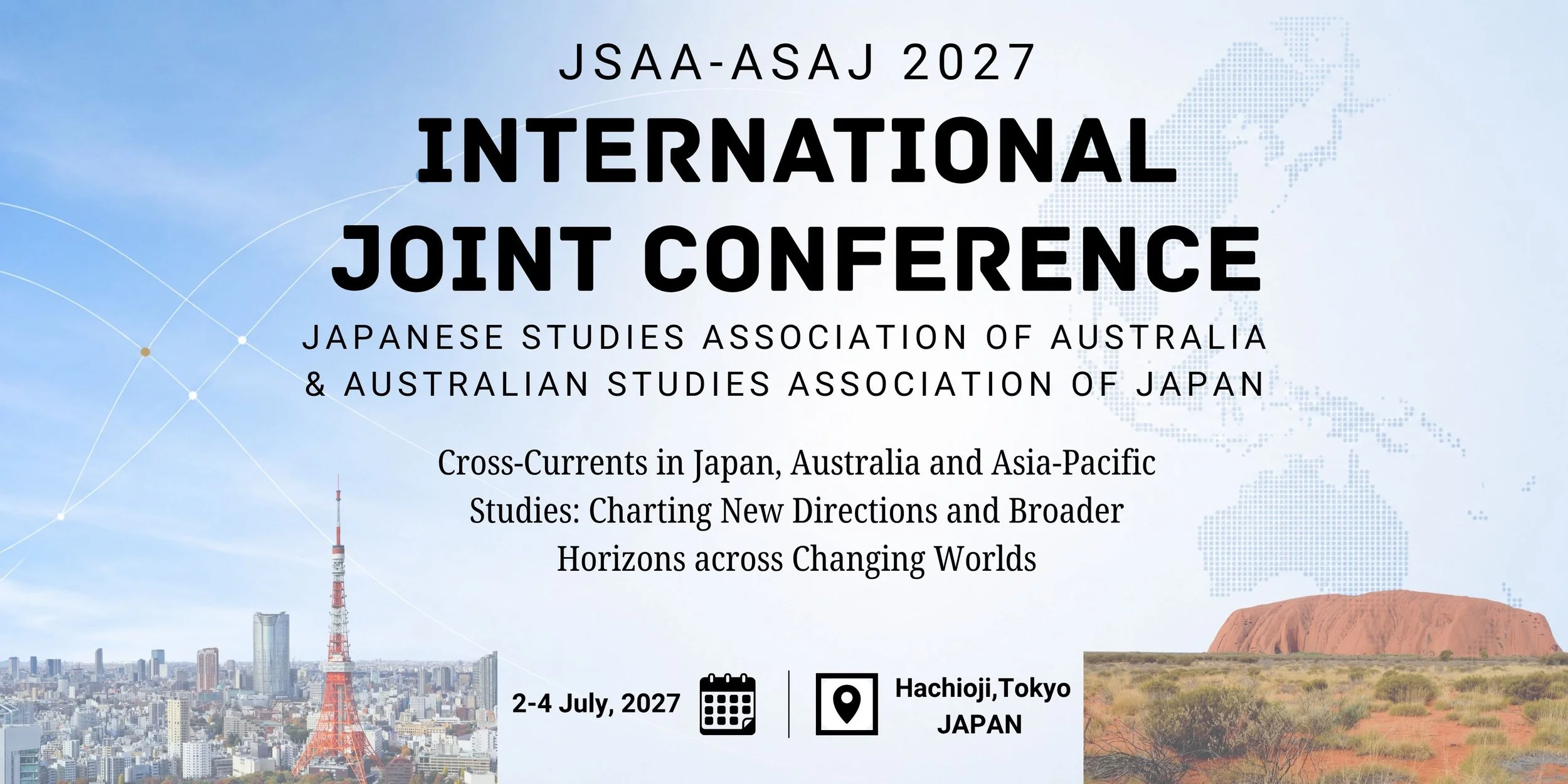
2027 JSAA-ASAJ Joint International Conference
The Japanese Studies Association of Australia (JSAA) and the Australian Studies Association of Japan (ASAJ) warmly invite proposals for the 2027 JSAA-ASAJ Joint International Conference, to be held at Tokyo Tama Mirai Messe, Hachioji, Tokyo, from Friday 2 July to Sunday 4 July 2027.
The conference theme is “Cross-Currents in Japan, Australia and the Asia-Pacific Studies: Charting New Directions and Broader Horizons across Changing Worlds.” The conference will bring together scholars working across Japanese Studies, Australian Studies, Asia-Pacific Studies, and related fields to consider how these areas of inquiry might be rethought beyond narrowly national or bilateral frameworks.
We are pleased to confirm the following keynote speakers and symposium participants: Tessa Morris-Suzuki (Australian National University), David Chapman (The University of Queensland), Shin Takahashi (Monash University), Emi Otsuji (University of Technology Sydney) and Paula Gerber (Monash University; The University of Tokyo). The conference will also include individual papers, organized panels, poster presentations, and other formats, including book sessions, art-based presentations, and workshop-style sessions.
We especially encourage graduate students and early-career researchers (HDR/ECR) to apply. A postgraduate and early-career researcher workshop is scheduled for the first day of the conference, Friday 2 July 2027, and travel grants will be available for selected doctoral students and early-career researchers.
Submissions are accepted from September 1st to November 1st 2026. Full details, including the call for papers and submission forms, are available on the conference website, which includes both Japanese and English pages:
https://conference.wdc-jp.com/australianstudies/jsaa-asaj2027/
While this is a joint conference between JSAA and ASAJ, and as reflected in the conference theme, we warmly welcome submissions from scholars working in Japan, Australia, across the Asia-Pacific, East Asia, Southeast Asia, and globally more generally.
The 2027 JSAA-ASAJ Joint International Conference Organising Committee
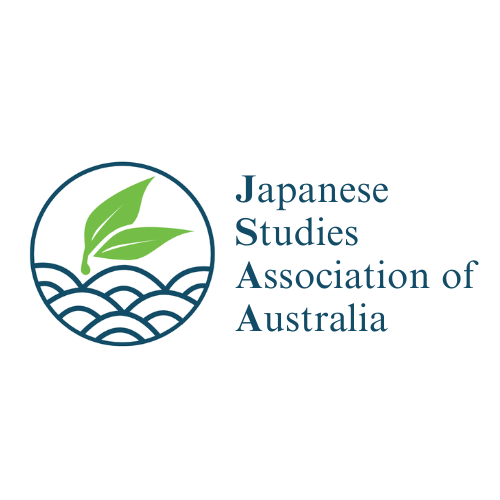
NEW LOGO DESIGN
Logo Design Concept
1. Waves (Seigaiha-inspired motif): Japanese Identity and Internationality
The wave motif at the lower part of the design draws inspiration from Seigaiha, a traditional Japanese pattern. The repeated, continuous waves symbolize the totality of Japanese culture as it has developed beyond temporal and disciplinary boundaries, as well as the layered depth of its long history.
At the same time, waves are a universal symbol of movement and exchange. By evoking the transoceanic circulation of people, languages, and cultures, this motif highlights that Japanese Studies is not a field confined within national borders, but one that unfolds within international and transnational networks of scholarly engagement.
2. Eucalyptus Leaves: Australian Identity and Growth
The leaves positioned at the upper part of the design represent the eucalyptus, a plant emblematic of Australia. Leaves are commonly associated with growth, suggesting the ways in which Japanese Studies has been nurtured and has evolved within Australian society over time.
Within the circular form, the leaves are arranged in a dialogic relationship with the wave motif, creating a composition in which Australia (eucalyptus) and Japan (waves) coexist within a shared space. This visual structure does not imply hierarchy or subordination; rather, it expresses a balanced and reciprocal relationship between the two.
3. Circular Composition: Scholarly Community
The circular form that encloses the entire logo signifies that Japan and Australia are not positioned in a closed or oppositional relationship, but are instead encompassed within a shared scholarly community. The circle represents an inclusive academic space in which dialogue, collaboration, and mutual engagement take place.
4. Degree of Abstraction: A Design Not Confined to a Single Culture
Both the wave and the leaf are rendered in deliberately abstract forms, avoiding highly realistic representation. This abstraction serves to prevent overt nationalism or excessive folkloristic emphasis, presenting Japanese Studies instead as a contemporary and open academic field. At the same time, this level of abstraction achieves a balance between neutrality and symbolism, qualities that are essential for an international scholarly association.
5. Typeface: Commonality within the International Academic Community
The typeface used in the logo is Times New Roman, a standard font that has long been widely employed in academic publications and scholarly associations worldwide. This choice underscores the position of Japanese Studies as a discipline clearly situated within the international academic community.
海外在住研究者に対する「個人向けデジタル化資料送信サービス」利用制限の見直しに関する要望書 (26 May 2025)
A letter of request regarding the restrictions on overseas researchers' usage of the National Diet Library's "Digitised Contents Transmission Service for Individuals"
In Loving Memory of Carol Hayes
It is with great sadness that we inform you of the passing of Professor Carol Hayes.
Many of you would know of Carol’s ongoing battle with brain cancer. Carol passed away surrounded by loved ones on Sunday the 16th of October.
Carol’s contribution to Japanese Studies and to the JSAA has been enormous. She was a longstanding member of the JSAA and held various roles on the executive at different times including President from 2013-2015. She was consistently a positive and important presence mentoring ECRs, postgraduate students and colleagues. Carol was recently recognised for her contributions in many areas within Japanese/Asian Studies, Japanese language education and, more generally, her various roles at ANU, with a promotion to the position of Professor.
Carol will be greatly missed not only for her academic contributions, but also her warmth, kindness and cheeky sense of humour.
The JSAA objects to the closure of the Japanese language program at Swinburne University, and the executive has written letters demanding a review of the decision to the Swinburne management as well as the Minister for Education and the Shadow Minister for Education. You can help by signing this petition:
Upcoming events.
If you wish to forward information regarding events, conferences, job opportunities and the like for this calendar please contact the Secretary Dr Satoshi Nambu.